 Back to News
July 6, 2026
|
SUMMARY - Long term value over upfront cost: lifecycle and maintenance matter most. - Maintenance is king: easier to clean, repair and manage wins. - Parks need to do more: higher use, longer stays, stronger community outcomes. - Comfort drives use: shade, shelter and climate-responsive design are essential. - Inclusion is moving beyond compliance: focus is on real-world usability. |
4 months, 18,500kms, 150 councils, and 1,000+ conversations. The GX Outdoors Expect More Roadshow has been incredibly well received and, to be honest, has exceeded our expectations!
Whilst it was important to give councils a real-life look at the product developments we’ve been working on over the past 18 months, what proved far more valuable have been the conversations, the connections we're building, the discussions that have unfolded, and the opportunity to visit sites and see firsthand how these spaces are actually being used.
We understood the general challenges councils were facing, but being out there shifted that understanding by adding context, detail and, in many cases, a different perspective.
What became clear early is that while context shifts from region to region, the underlying pressures don’t, with the same conversations surfacing consistently, shaped slightly by climate, budget and local constraints.
Here’s just some of what we heard…
How decisions are being made now
There’s a much stronger focus on value, but not in a surface-level sense, with cost still playing a role but increasingly being weighed against everything that comes after installation, including maintenance, replacement, frequency of intervention and whether components can be replaced or entire assets need to be removed.
There is also more consideration around how spaces are used now and how that will continue to evolve, particularly as community expectations shift and usage patterns change over time, which means decisions are being made with a longer-term view in mind.
Maintenance
Maintenance is no longer being discussed in general terms, with feedback becoming far more specific and grounded in day-to-day realities.
Teams walked us through what servicing assets actually looks like, from grease traps that are difficult to access through to cleaning processes that take longer than they should, along with the ongoing challenge of managing build-up, wear and vandalism within limited time and resource constraints.
There is a clear preference for solutions that reduce effort, simplify processes and minimise the need for repeated intervention over time.
Vandalism continues to be a constant, and is something that teams actively plan for, with a focus on how quickly assets can be repaired, parts replaced and spaces returned to a usable state.
This often extends to teams adapting solutions themselves, whether that’s sourcing parts, modifying components or finding workarounds to keep assets functional.
There’s also the added layer of councils inheriting parks from developers and managing the consequences of decisions they didn’t make, particularly where material choices, layouts or finishes may look appropriate at handover but create ongoing maintenance challenges once the space is in use.
Doing more with less space
As density increases and the traditional backyard becomes less common, public space is carrying more of the load, with people using parks differently, staying longer and expecting more from them.
This is shifting how spaces are considered, with less focus on individual elements and more attention on how everything works together to support different types of use across the same space.
A conversation in Victoria captured this shift well, highlighting a move away from thinking about parks as a collection of assets and towards considering how a space supports connection, which in turn influences how layout, movement, seating and shelter are approached.
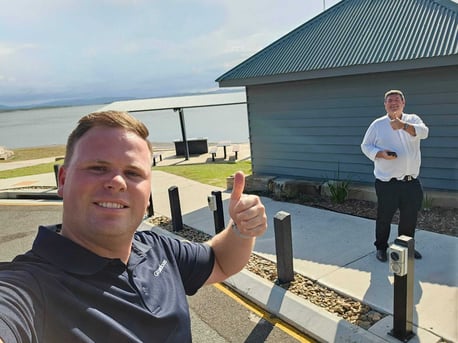
Have you seen our Roadshow video series? Watch it now

Climate and comfort
Climate plays directly into how these spaces perform, with comfort now expected rather than optional.
If a space is too hot, too exposed or too uncomfortable, it simply won’t be used, and while the specific challenges vary depending on location, the expectation that spaces need to work across more of the year is consistent.
This is influencing decisions around shelter, orientation and material selection in a much more deliberate way.
Standardisation vs flexibility
 |
|
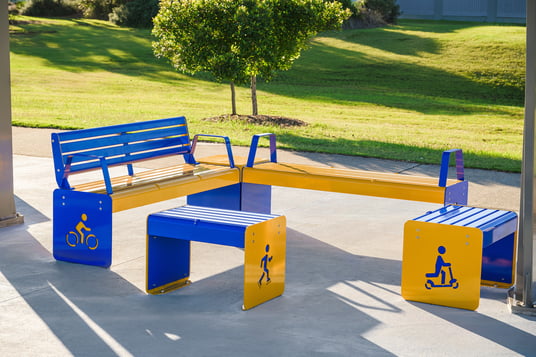
Semi-custom Hyve park furniture by GX Outdoors installed at Raby Bay Espalande in Qld |
There is also a noticeable tension between standardisation and flexibility, with many councils working within established palettes and specifications that support procurement and maintenance, while project teams are increasingly looking to respond to specific sites and create more tailored outcomes.
Balancing those competing priorities is becoming more complex as expectations around design continue to evolve.
Inclusion
Inclusion is being approached with more intent, with a growing awareness that compliance alone doesn’t necessarily result in spaces that feel usable or intuitive for everyone.
The focus is shifting towards how spaces function in practice across a broader range of users and communities, rather than relying on individual features to address inclusion in isolation.
Products that work and where it’s all heading
From a product perspective, what people were drawn to reflected many of these broader themes, with the roll-out drawer and grease trap consistently attracting attention due to their relevance to maintenance challenges.
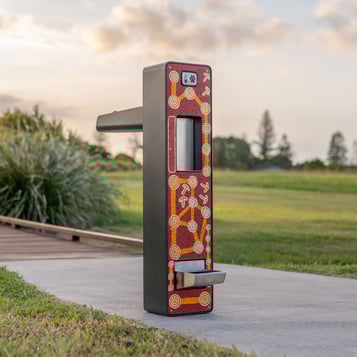
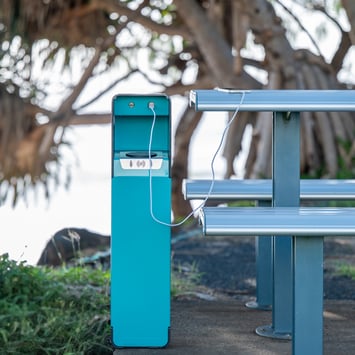
The Akuna Fountain was of particular interest for councils with DDA considerations, especially in relation to internal water management, while products like the Charge ‘n’ Chill and finishes such as TimberImage and Sable Corten generated strong engagement for different reasons across stakeholders.
 |
 |
|
GX Outdoors Akuna Drinking Fountain (left) and Charge N Chill device charging station (right) |
|
What the roadshow reinforced more than anything is that expectations of public space have shifted, with parks now required to do more, carry more and perform over longer periods of time.
The people responsible for delivering these spaces are balancing cost, maintenance, usability and long-term value simultaneously, often within increasingly tight constraints, and spending time on the ground in these conversations brings that into much sharper focus.
For more insights, watch our Expect More Roadshow VLOG or book the GX Van to stop where you are below.